
Notary Public in Bacolod City
Visit Our Law Office
Location: #202, 2F, Capitol Subdivision Inc. Building,
16th Lacson Street, Bacolod City, Negros Occidental.
Appointment-based only; no specific hours. We can accommodate night hours.
Documents We Notarize
We provide drafting and notarization services for a wide range of legal and commercial documents, ensuring they are valid, binding, and compliant with the 2004 Rules on Notarial Practice.
- Affidavits: Judicial affidavits, affidavits of loss, affidavit of consent, affidavit of declaration of heirship.
- Real Estate & Property: Deeds of Absolute Sale, Contracts to Sell, Deeds of Donation, and Extrajudicial Settlements of Estate.
- Business & Corporate: Secretary’s Certificates, Articles of Incorporation, Commercial Contracts, and Non-Disclosure Agreements (NDAs).
- Representation: Special Power of Attorney (S.P.A.) and General Power of Attorney (G.P.A.).
- Personal & Legal Declarations: Affidavits of Loss, Affidavits of Discrepancy, Oaths, and Jurats.
- Personal Data Sheet (PDS)
- Real Estate Mortgage Documents
We also perform the following notarial acts:
- Signature Witnessing
- Copy Certification (Certified True Copy)
- Jurat
- Acknowledgement
What to Bring Before Your Visit
(1) To protect you from fraud and to comply with Supreme Court regulations, all signatories must appear in person at our Bacolod office (or in a designated place within Talisay City, Murcia, or DSB by request).
(2) Bring an unsigned and integrally complete document. (E.g., if your Affidavit enumerates annexes, kindly attach all corresponding annexes)
(3) Please bring at least ONE (1) valid, unexpired government-issued ID bearing your photograph and signature:
- Passport
- Driver’s License
- UMID / SSS ID
- PRC ID
- PhilID (National ID)
- Voter’s ID
(Note: Cedula/Community Tax Certificate is no longer accepted as the sole proof of identity for notarization).
Certification from ENotary Facility
Also certified by an E-Notary Facility as a pre-requisite for Electronic Notarization starting October 19, 2026.

FAQ
Notary Public in Bacolod City: Frequently Asked Questions
1. Why must I make sure my notary public is legitimate?
Because a legitimate notarization is the only thing that turns your private agreement into a public document, and a public document is the only version the government will act on.
A real notary public in the Philippines must be a lawyer in good standing who holds a current notarial commission issued by the Executive Judge of the Regional Trial Court. That commission carries a duty most people never see: the notary records every notarial act in an official notarial register, and each month submits certified copies of those entries, together with duplicate originals of the documents notarized, to the Clerk of Court of the Regional Trial Court.
This is what protects you. Once your deed is properly notarized, a copy of it lives permanently in the court archives as part of the public record. If your copy is lost in a fire or a flood, if a party denies ever signing, or if a dispute erupts twenty years from now, a certified copy can be requested from the Clerk of Court. Your document does not depend on anyone’s goodwill or filing cabinet.
If the “notary” is not legitimately commissioned, or the commission had already expired, none of that exists. Nothing was entered in a register. Nothing was transmitted to the court. There is no archived copy to retrieve, and your document remains a mere private paper.
This is most dangerous in high-value property transactions. A Deed of Absolute Sale that was never validly notarized cannot be registered with the Registry of Deeds and will not support the issuance of a BIR electronic Certificate Authorizing Registration. Without those, no new Transfer Certificate of Title can ever be issued in your name. You will have paid the purchase price in full and still hold no registrable transfer, and no protection against a third party who later buys the same land and registers first. The agreement may still bind the persons who actually signed it, but on paper, before the Registry and the whole world, the land never moved.
Verifying your notary takes five minutes. Undoing a defective transfer can take years of litigation.
2. How do I verify that a notary public in Bacolod City is legitimately commissioned?
Four practical checks:
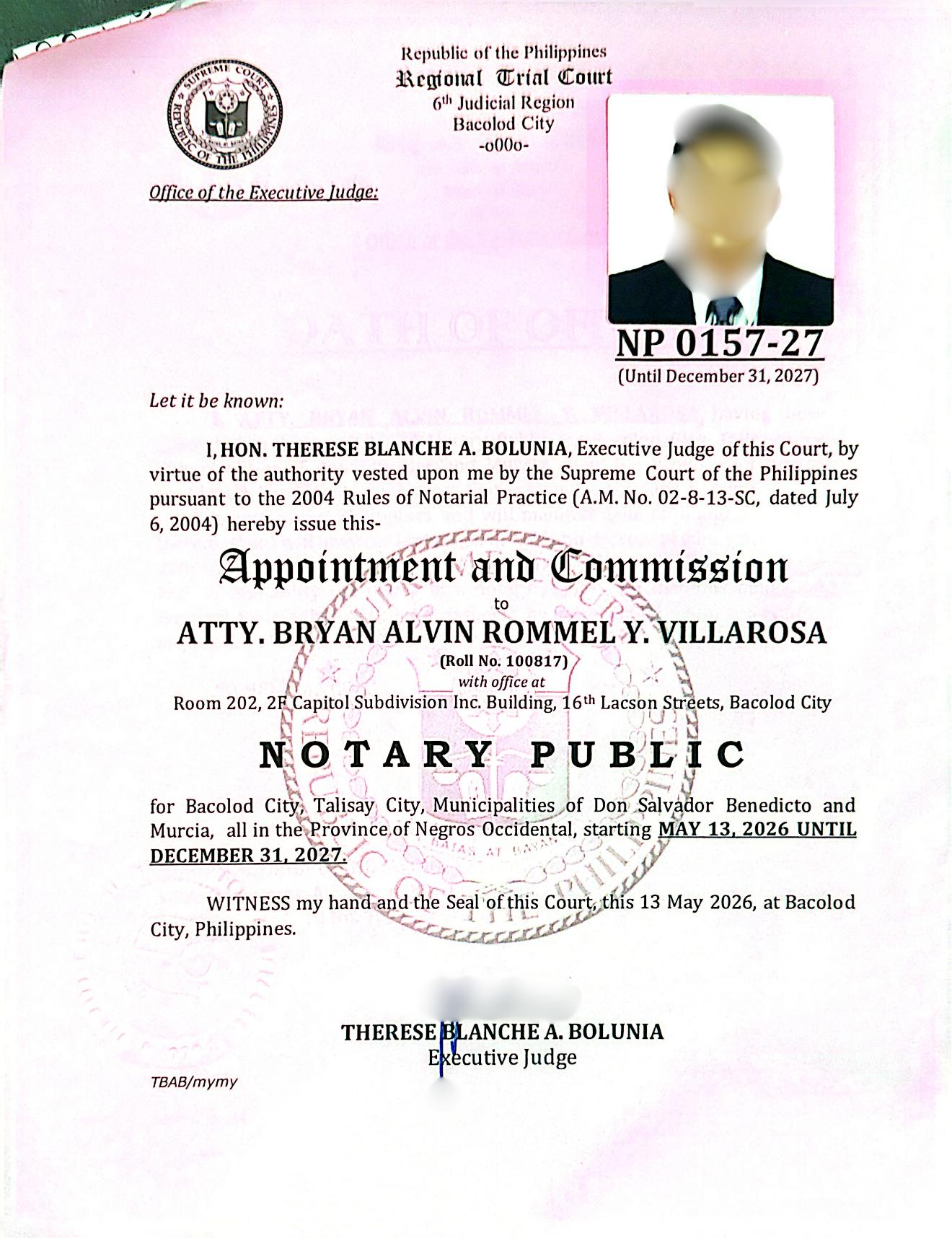
- Ask to see the notarial commission itself. It names the notary, the commissioning court, and the exact period of validity.
- Check the expiry date. Commissions run for two years and lapse on 31 December of the second year. A notarization performed on an expired commission is defective.
- Verify with the Office of the Clerk of Court of the Regional Trial Court of Negros Occidental, which maintains the roster of commissioned notaries.
- Confirm the person is a lawyer. Only lawyers may be commissioned. The Supreme Court’s Roll of Attorneys and the Integrated Bar of the Philippines chapter can confirm standing.
A genuine notary will never be offended by these questions.
3. Where can I find a notary public near me in Bacolod City?
Our notarial office is located at the 2nd Floor, Capitol Subdivision, Inc. Building, corner 16th and Lacson Streets, Bacolod City, Negros Occidental. We serve scheduled notarial requests for individuals, families, and businesses across Bacolod and the surrounding municipalities.
You may call or message ahead to confirm availability, especially for deeds, multi-party documents, or transactions requiring witnesses.
Call 09088128227
4. Ano ang notaryo publiko, kag ano ang iya obra?
Ang notaryo publiko isa ka abogado nga ginhatagan sing awtoridad sang Regional Trial Court agod pamatud-an nga ang mga tawo nga nagpirma sa isa ka dokumento amo gid ang matuod nga tawo, kag nga ginpirmahan nila ini sa ila kaugalingon nga kabubut-on.
Kon ma-notaryo na, ang dokumento nangin public document. Ini nagakahulugan nga ginakilala ini sang gobyerno, sang Registry of Deeds, sang BIR, kag sang korte. May kopya man nga ginapadala sa korte kada bulan, gani may permanente nga rekord.
Ang notaryo indi lang basta nagatatak. Ginapamatud-an niya ang identidad, ginapamangkot kon nakaintiende ka sa imo ginapirmahan, kag ginasulat ini tanan sa iya notarial register.
5. How much does notarization cost in Bacolod City?
Notarial fees in this province follow the schedule of fees adopted by the Integrated Bar of the Philippines, Negros Occidental Chapter.
Simple documents such as affidavits, special powers of attorney, and consent letters are charged at a fixed rate. Documents conveying property, such as deeds of sale, extrajudicial settlements, and mortgages, are charged on an ad valorem basis, meaning the fee is computed from the value of the property or the consideration stated in the document.
A word of caution on searching for the cheapest notary you can find. Notarial fees are a small fraction of the cost of a property transaction, and an unusually low fee sometimes signals a notary who is not actually commissioned, or who will not observe the personal appearance and identification requirements that make the notarization hold up later.
6. What do I need to bring to have a document notarized?
Three things:
- The document itself, complete and final, but unsigned. You must sign in the presence of the notary.
- Competent evidence of identity, meaning at least one current government-issued identification document bearing your photograph and signature. Passports, driver’s licenses, UMIDs, PhilSys national IDs, PRC licenses, and postal IDs are commonly accepted. Expired IDs are not.
- All signatories, physically present. See the next question.
For corporate documents, bring the board resolution or secretary’s certificate authorizing the signatory to act. For property documents, bring a copy of the title and the latest tax declaration so the description can be checked against the deed.
7. Do all the parties really have to appear in person? Can I just send the signed document through someone?
No, and this is the single most common misunderstanding.
Under the 2004 Rules on Notarial Practice, every person whose signature is being notarized must personally appear before the notary at the time of notarization, and must be identified through competent evidence of identity. A notary who stamps a document brought in by a messenger, a broker, or a relative is committing an act for which lawyers are regularly suspended or disbarred.
This rule exists for your protection. Personal appearance is what makes forgery difficult and what gives your notarized deed its evidentiary weight in court.
If a signatory is abroad, the document can be executed before the Philippine Embassy or Consulate with jurisdiction over that place, or apostillised in accordance with the requirements of that country. If a signatory is elderly or ill, arrangements can be made, but appearance before the notary is still required.
8. What is the difference between an acknowledgment and a jurat?
Both are notarial acts, but they certify different things.
An acknowledgment is used for contracts and conveyances, such as deeds of sale, mortgages, and powers of attorney. The signatory appears before the notary and declares that the signature is his and that he executed the document freely and voluntarily. It certifies voluntariness.
A jurat is used for affidavits and sworn statements. The signatory appears, signs in the notary’s presence, and swears under oath that the contents are true. It certifies truthfulness under oath, and a false statement can expose the affiant to perjury.
Using the wrong form can render a document defective for its intended purpose. This is one reason to have a lawyer prepare, and not merely stamp, an important document.
9. Why does a Deed of Sale of land have to be notarized?
Three separate systems require it:
- The Civil Code requires that acts and contracts involving real property appear in a public instrument.
- The Bureau of Internal Revenue will not process the capital gains or creditable withholding tax and documentary stamp tax, and will not issue the electronic Certificate Authorizing Registration, on the basis of an unnotarized deed.
- The Registry of Deeds will not register the conveyance or issue a new Transfer Certificate of Title without a notarized deed and the corresponding eCAR.
Practically, an unnotarized deed of sale leaves you holding a piece of paper that no government office will honour. The seller remains the registered owner in the eyes of the law, and you carry the risk that the property is sold again, mortgaged, or attached by the seller’s creditors.
10. What happens if the notary’s commission had already expired when my document was notarized?
The notarization is defective. In legal effect, the document is treated as a private document, which means it loses the presumption of regularity and cannot simply be presented in court or at the Registry without further proof of its execution.
For a deed affecting land, this usually means the transaction cannot proceed until the document is re-executed and properly notarized. If a party has since died, moved abroad, become incapacitated, or simply changed his mind, re-execution can become extremely difficult, sometimes impossible without going to court.
The lawyer who notarized on an expired commission also faces administrative liability before the Supreme Court, but that is cold comfort to the buyer holding the defective deed.
If you suspect this has happened to your document, have it reviewed promptly. The problem is far easier to fix while everyone who signed is still available and willing.
11. Can I still get a copy of a document that was notarized years ago?
Usually yes, and this is one of the strongest practical arguments for using a properly commissioned notary.
Because notaries are required to transmit copies of their notarial register entries and duplicate originals to the Clerk of Court of the Regional Trial Court, notarized documents form part of the court’s archived records. A certified copy may generally be requested from the Office of the Clerk of Court, subject to its procedures, fees, and the applicable rules on access.
You will need to supply identifying details: the names of the parties, the nature of the document, the approximate date, and the name of the notary if you know it. The more precise your information, the faster the retrieval.
If the document was never validly notarized, there is nothing in the archive to retrieve.
12. Can a Bacolod notary public notarize a document for property located in another province?
Yes, with an important distinction.
The limitation is on where the notarial act is performed, not on where the property sits. A notary public commissioned in Bacolod City may perform notarial acts only within the territorial jurisdiction of the commissioning court. The notarization must physically happen there.
But the subject of the document can be anywhere. A deed covering land in Iloilo, Cebu, or Palawan can validly be notarized in Bacolod, provided the parties appear here.
The reverse is what invalidates documents: a Bacolod-commissioned notary who notarizes while outside his territorial jurisdiction has performed a defective act, regardless of where the property is.
13. Is online or electronic notarization allowed in the Philippines?
Yes, within limits. The Supreme Court approved the Rules on Electronic Notarization on 4 February 2025, and they took effect on 9 March 2025. These rules created Electronic Notaries Public, who may perform notarial acts for principals located anywhere in the Philippines, which removes the territorial restriction that applies to traditional notaries, and they allow in-person electronic notarization, remote electronic notarization by videoconference, or a combination of both through accredited software.
Two limits matter for most clients:
- The rules apply only to electronic documents in PDF or PDF/A format. Paper documents bearing handwritten signatures remain governed by the 2004 Rules on Notarial Practice.
- Notarial wills and depositions are excluded.
For a principal who is abroad, an electronic notarial act may be performed only if that person is physically within the premises of a Philippine embassy, consular office, or honorary consul’s office at the time.
If you are dealing with a conventional signed paper deed, personal appearance before a commissioned notary is still the rule.
14. What documents commonly need to be notarized?
Property and business Deeds of absolute sale, contracts to sell, deeds of assignment, real estate mortgages, extrajudicial settlements of estate, waivers of rights, lease contracts, and secretary’s certificates.
Personal and family Special powers of attorney, general powers of attorney, affidavits of loss, affidavits of support and consent for minors travelling abroad, parental consent documents, and affidavits of no income.
Employment and compliance Quitclaims and releases, joint affidavits, affidavits of undertaking, and sworn statements for government agencies.
If you are not certain whether your document needs notarization or a different form of authentication such as an apostille, ask before you sign. The sequence matters, and signing prematurely often means starting over.
Need a commissioned notary public in Bacolod City?
Villarosa Law Office provides notarial services alongside full legal review of the documents we notarize. For property transactions in particular, we check the title, the technical description, the tax declaration, and the parties’ capacity before anything is signed, so that the document you walk out with is one the Registry of Deeds and the BIR will actually accept.
Call 09088128227
This page is general legal information about notarial practice in the Philippines and is not legal advice. Reading it does not create a lawyer-client relationship. For advice on your specific document or transaction, please consult a lawyer.